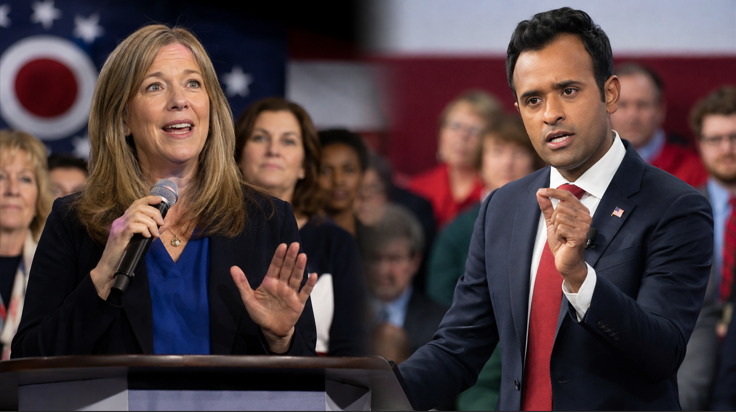
Amy Acton is giving Democrats something they have not had in Ohio’s governor’s race for years: a genuine chance to win. Recent polling has shown Acton competitive with—and in some surveys ahead of—Republican nominee Vivek Ramaswamy. That has helped transform a contest Republicans once expected to control into one of the most closely watched gubernatorial races of 2026. The Cook Political Report now rates the race as a toss-up, underscoring how much the political environment has shifted.
Acton’s strength is especially notable because Ohio has moved sharply toward Republicans in recent election cycles. Donald Trump carried the state, Republicans control much of state government, and Ramaswamy entered the race with national name recognition, personal wealth, and Trump’s endorsement. He also won the Republican primary comfortably. On paper, those advantages should have made him the clear favorite. Instead, the general election is developing into a far more competitive fight.
Acton brings a very different profile. A physician and former director of the Ohio Department of Health, she became one of the state’s most recognizable public figures during the COVID-19 pandemic. Her leadership during that period made her admired by many Ohioans and intensely criticized by others. That history gives Republicans an obvious line of attack, but it also gives Acton something many first-time candidates lack: voters already know who she is and have seen her make difficult decisions under enormous pressure.
Ramaswamy, meanwhile, has spent much of his recent political career building a national conservative brand. The biotech entrepreneur became prominent during the 2024 Republican presidential primary before backing Trump, and his campaign for governor has emphasized culture-war themes, economic policy, and opposition to what he calls “woke” institutions. But recent reporting suggests he has had difficulty connecting with some Ohio voters, while questions about his style, priorities, and focus on national politics have created openings for Acton.
The polling should still be treated cautiously. Surveys have produced different margins throughout the campaign, and earlier polling has alternated between narrow Acton leads and small Ramaswamy advantages. That means no one should interpret a single favorable survey as proof that Ohio has suddenly become a Democratic state. What the numbers do show is that Acton has remained competitive enough to prevent Republicans from treating the race as a formality.
That alone could have national consequences. If Republicans are forced to spend heavily defending Ohio’s governor’s mansion, money and campaign attention that might have gone elsewhere will have to remain in the state. Ohio is already presenting the GOP with challenges in several races, including competitive congressional and Senate contests. A strong Acton campaign would add another major battlefield to a political map Republicans hoped would be far more comfortable.
For Acton, the challenge is now to turn favorable attention into a broader coalition. Winning Ohio would require more than Democratic turnout in Columbus, Cleveland, and other urban areas. She would need strong suburban support, better margins among working-class voters, and enough independents and moderate Republicans to overcome the state’s underlying Republican lean. Her campaign will also have to convince voters that her agenda extends beyond public health and that she can handle affordability, jobs, education, infrastructure, and the other issues that dominate a governor’s responsibilities.
If Acton ultimately defeats Ramaswamy, the result would be one of the biggest political stories of the 2026 election. It would show that Republican dominance in Ohio is not absolute and that even a Trump-backed national figure can be vulnerable when voters are offered a credible alternative. The race is far from over, but one thing is already clear: Republicans can no longer assume Ohio’s governorship belongs to them. Amy Acton has made them fight for it.