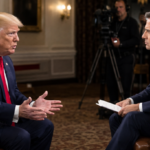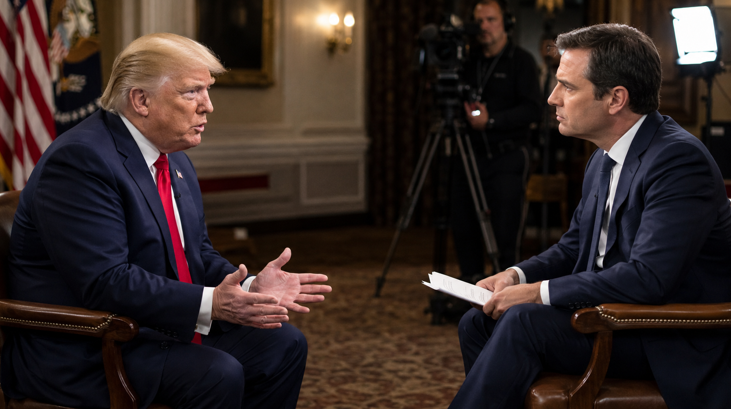
Donald Trump’s latest interview with Punchbowl News produced a brief exchange that quickly became more memorable than many of the policy questions surrounding it. During a wide-ranging conversation with journalist Jake Sherman, Trump declared that “a lot of people” were calling him one of the greatest presidents in American history. Sherman did not simply let the claim pass. He immediately responded that “they’re not saying that,” forcing Trump to defend the boast instead of allowing it to become an uncontested talking point.
Trump’s comment came while Sherman was asking about the political consequences Republicans could face if Democrats win control of the House in the 2026 midterms. Sherman raised the possibility of investigations and even another impeachment attempt. Trump answered by pivoting toward his own record, saying people regarded him as one of the country’s greatest presidents and pointing to what he described as historic economic investment. Sherman quickly redirected him back toward the original question.
That interruption stood out because Trump interviews frequently depend on whether the interviewer challenges sweeping claims in real time. A statement about being among the greatest presidents is ultimately an opinion rather than an objectively measurable fact, but public polling provides useful context. Trump has recently faced deeply negative approval numbers from several national surveys, while Democrats have gained momentum heading toward the midterms. In that environment, Sherman’s response highlighted the gap between Trump’s description of his popularity and the considerably more complicated picture presented by current public opinion.
The conversation also revealed that Trump understands the political danger facing congressional Republicans. He acknowledged voter frustration with GOP lawmakers while insisting that anger was not directed at him personally. Trump also questioned whether his supporters would turn out with the same intensity when his own name was not on the ballot. That concern matters because Republican candidates hoping to preserve congressional majorities depend heavily on voters who participate enthusiastically in presidential elections but may be less reliable during midterms.
Iran, election legislation and the stalled nomination of Todd Blanche were also part of the discussion. Punchbowl News’ Fly Out Day interviews are designed around congressional politics, giving reporters opportunities to press lawmakers and administration officials on legislative strategy rather than simply campaign messaging. Sherman has repeatedly used the format to question political leaders directly about the issues driving Capitol Hill.
Another exchange showed how little patience Sherman had for letting Trump move indefinitely away from the question being asked. When Trump launched into a discussion of China and wind energy, Sherman interrupted by questioning why Trump remained so focused on the subject. The interview therefore became notable less because Sherman delivered a lengthy confrontation and more because he repeatedly refused to allow unrelated claims to derail the conversation.
There is nothing unusual about politicians exaggerating their accomplishments or describing themselves in historically flattering terms. Journalists, however, do not have to accept those descriptions as the premise of an interview. Their job is to question, provide context and challenge assertions when appropriate. Sherman’s five-word response worked because it accomplished exactly that without turning the exchange into a speech of his own.
The moment will not determine the midterm elections or settle historical arguments about Trump’s presidency. But it demonstrated why direct questioning still matters. Trump offered an expansive claim about how Americans supposedly view him, and Sherman challenged it immediately while sitting across from him. In an era when political interviews can easily become platforms for rehearsed messaging, that simple refusal to nod along became the part viewers remembered most.